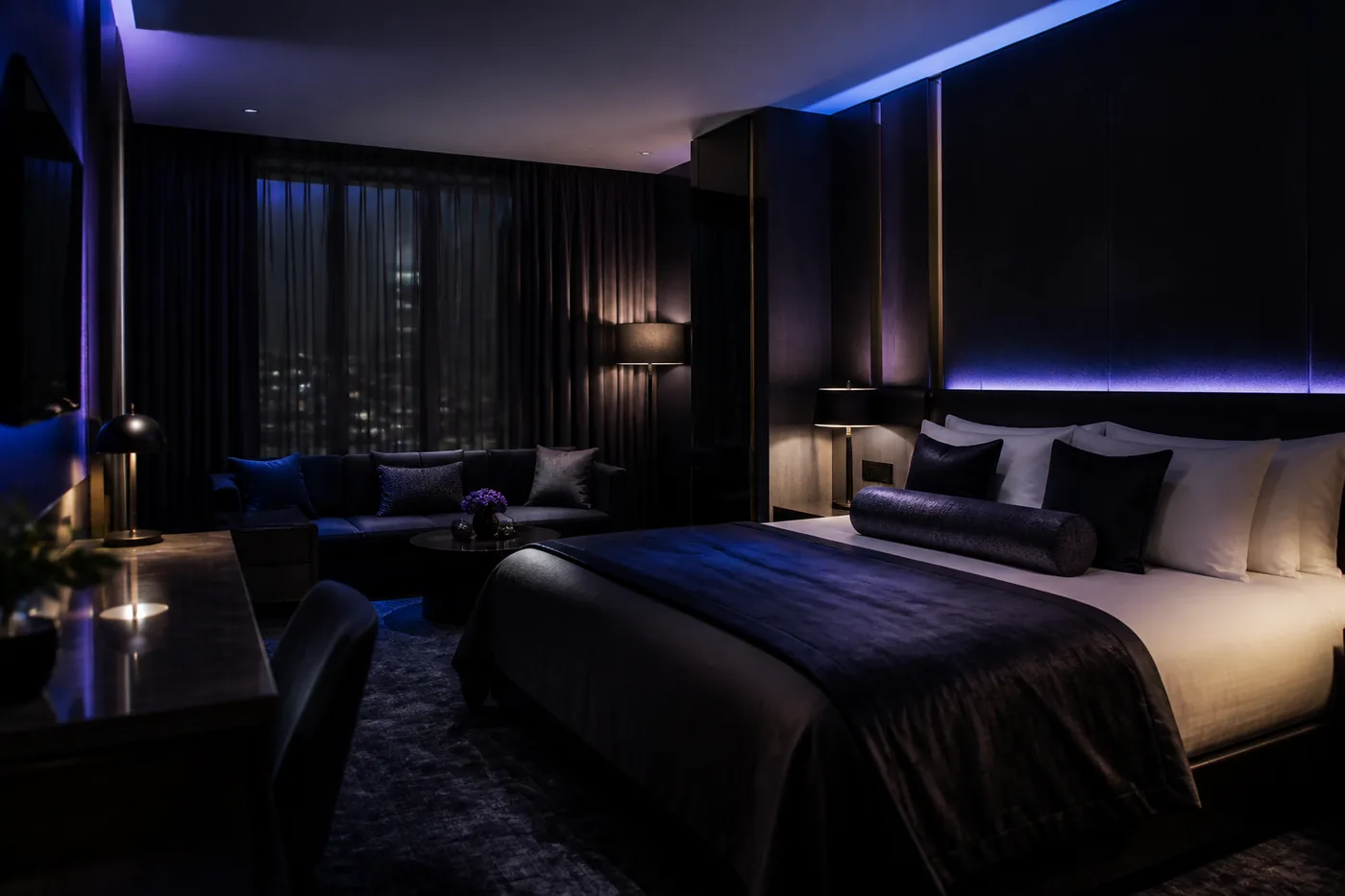
Hotel furniture costs roughly $6,000 to $12,000 per room at the economy and midscale tiers, $12,000 to $25,000 at upscale, and $25,000 to $50,000 or more for luxury and high-design boutique properties, counting guest room FF&E only (casegoods, beds and headboards, seating, lighting, window treatments, artwork), before public spaces, and before the freight-and-installation stack that adds another 25–40% on top of product cost.
We've priced these packages for hotel groups for fifteen years. Let's break the number down the way we would for an owner's proforma, including the question we've heard in a dozen forms: "we have $500,000 for furniture in the construction budget. Is that enough?"
What does hotel furniture cost per room, by tier?
Guest room furniture package, per key, product cost:
- Economy (exterior-corridor, hard-budget): $4,500–$8,000. Laminate casegoods, metal bed frames, minimal soft seating.
- Midscale / upper midscale (the select-service heartland): $8,000–$15,000. Full HPL casegoods package, upholstered headboard, desk and task chair, one lounge piece, blackout drapery.
- Upscale: $15,000–$25,000. Better materials (veneer accents), larger seating, layered lighting, upgraded window treatments.
- Luxury / high-design boutique: $25,000–$50,000+, where custom casegoods, designer fabrics, and statement pieces take over. Boutique-specific strategy is its own article: boutique hotel furniture.
Room mix moves the average: suites typically run 1.5–2.5x a standard king, and ADA rooms carry their own spec premiums. A "$10K per key" budget across a property with 15% suites is really an $11K+ blended reality.
So is $500,000 enough furniture budget?
Run the division and the tiers answer it:
- At economy/midscale spec (~$8K/key loaded): $500K furnishes roughly 60 keys' worth of guest rooms (a small select-service property), with little left for public areas.
- At upscale spec (~$18K/key loaded): about 28 keys. That's not a hotel; that's a floor.
- For a typical 100-key midscale new build, honest guest-room FF&E alone runs $800K–$1.2M loaded, plus public areas.
So when a $500K furniture line shows up in a $10M construction budget for a 100-key property, one of three things is true: the tier expectations are economy, the number excludes big categories someone assumes live elsewhere, or the proforma is optimistic and the gap will surface at the worst possible time. We've delivered that news in a lot of conference rooms. It's cheaper to hear it before the GMP is signed.
What's NOT in the per-key number?
The line items that ambush first-time hotel developers:
- Public areas: lobby, breakfast/restaurant, bar, meeting rooms, fitness, pool deck. Add 25–50% on top of the guest room total for select-service; more for full-service and boutique, where public space is the brand.
- Freight, receiving, warehousing, installation: 25–40% on top of product cost combined, at hotel scale with container logistics. The delivery chain is its own discipline. See FF&E logistics and installation.
- OS&E: linens, terry, glassware, irons, hangers. A separate budget, commonly $2,000–$5,000 per key.
- Mattresses: often a separate (sometimes brand-mandated) program, $600–$2,000+ per bed.
- Attic stock: the 2–5% spares that make year-four replacements possible. Cheap now, priceless later.
- Sales tax. On a seven-figure FF&E buy, six figures of tax is not a footnote.
What actually drives the cost up or down?
From most to least controllable:
- Quantity and SKU discipline. A 120-key order of one casegoods program prices dramatically better than boutique quantities of four programs. Volume mechanics are in the bulk ordering guide.
- Materials tier. HPL casegoods vs veneer is the single biggest per-key swing in the room, often $1,500–$4,000 per key by itself. The materials trade-offs are unpacked in the guest room furniture guide.
- Custom vs standard. Every custom piece pays design, tooling, and prototype costs your key count has to amortize.
- Origin and timing. Container-quantity import pricing beats domestic on most casegoods, if your calendar can absorb four to six months of lead time and your cash flow can fund deposits early.
- Brand mandates. If you're flagged, the brand's FF&E standards set your floor. There is no value-engineering your way below a PIP's requirements; there's only negotiating the PIP.
What do the individual pieces cost?
For sanity-checking line items, typical contract-quality unit ranges at hotel volume (midscale to upscale tiers; luxury goes beyond all of these):
- Casegoods set per room (headboard, two nightstands, dresser/console, desk): $2,500–$7,000
- Upholstered headboard alone: $400–$1,200
- Nightstand: $250–$700 each
- Desk: $350–$900; desk chair: $150–$450
- Lounge chair: $400–$1,200; sleeper sofa: $1,200–$3,000
- Lighting package per room (5–7 fixtures): $400–$1,000
- Window treatments per room (blackout drapery, hardware, install): $500–$1,500
- Artwork and mirror package: $250–$800
- Luggage bench: $150–$400
Add those up at the midpoints and you land right inside the midscale-to-upscale per-key ranges above, which is exactly the point: per-key benchmarks and piece prices should reconcile, and when a budget's pieces don't sum to its per-key claim, one of the two numbers is lying. Piece-level spec guidance (what those dollars should be buying in materials and construction) is in the guest room furniture guide.
How does renovation pricing differ from new-build?
Renovations ("soft goods reno" vs "full case goods reno" in brand language) run cheaper per key because scope is partial: a soft-goods cycle (fabrics, window treatments, mattresses, art, paint) might run $4,000–$8,000 per key, while a full renovation with new casegoods approaches new-build numbers plus demolition, disposal, and the operational cost of rooms out of service. One renovation-specific line everyone forgets: furniture disposal. Getting 100 rooms of old casegoods out of a tower and into trucks costs real money. Liquidators offset it less than owners hope.
Can I furnish a hotel with used or liquidated furniture?
The tempting shortcut, honestly assessed. Hotel liquidators sell casegoods and seating from renovated properties at 10–25 cents on the dollar, and for certain buyers it genuinely works: independent budget properties, extended-stay conversions racing a calendar, and back-of-house areas at any tier. The catches are structural, not cosmetic. You buy what exists: room counts rarely match, so a 92-room liquidation lot furnishes your 100-room property awkwardly. There are no spares, no warranty, no matching replacements ever, and the furniture arrives with six years of someone else's guest wear already on the clock. Branded properties usually can't touch it at all; brand standards specify current programs.
Our rule when owners ask: used is defensible for a property competing on price with a five-year plan and a flexible aesthetic. It's false economy for anyone selling the room as the product. The per-key savings evaporate into shorter replacement cycles and rooms that photograph exactly like what they are. Run the cost-per-year math, not the invoice math.
How do I keep the number honest?
The three-step sanity check we run on any hotel furniture budget:
- Benchmark: loaded per-key cost (product × 1.3) against the tier ranges above.
- Top-ten reality check: get live quotes on the ten biggest line items (casegoods set, seating package, window treatments). Ten quotes typically cover two-thirds of the spend, and turns a benchmark into a budget. The full method is in the FF&E budget guide.
- Calendar check: deposits for long-lead items go out 5–7 months before opening. A budget without a cash-flow curve is half a budget.
The short version
Guest rooms: $6K–$12K per key economy/midscale, $12K–$25K upscale, $25K+ luxury, product only. Multiply by 1.25–1.40 for freight, warehousing, and installation; add public areas; keep OS&E and mattresses separate; and check any pre-baked number (yes, including a $500K construction-budget line) against key count and tier before believing it.
If you want your number checked against live quotes instead of benchmarks, send us your key count, flag, and room mix. We'll come back with what the package really costs landed, and where the budget's soft spots are. Proformas are easier to fix than punch lists.