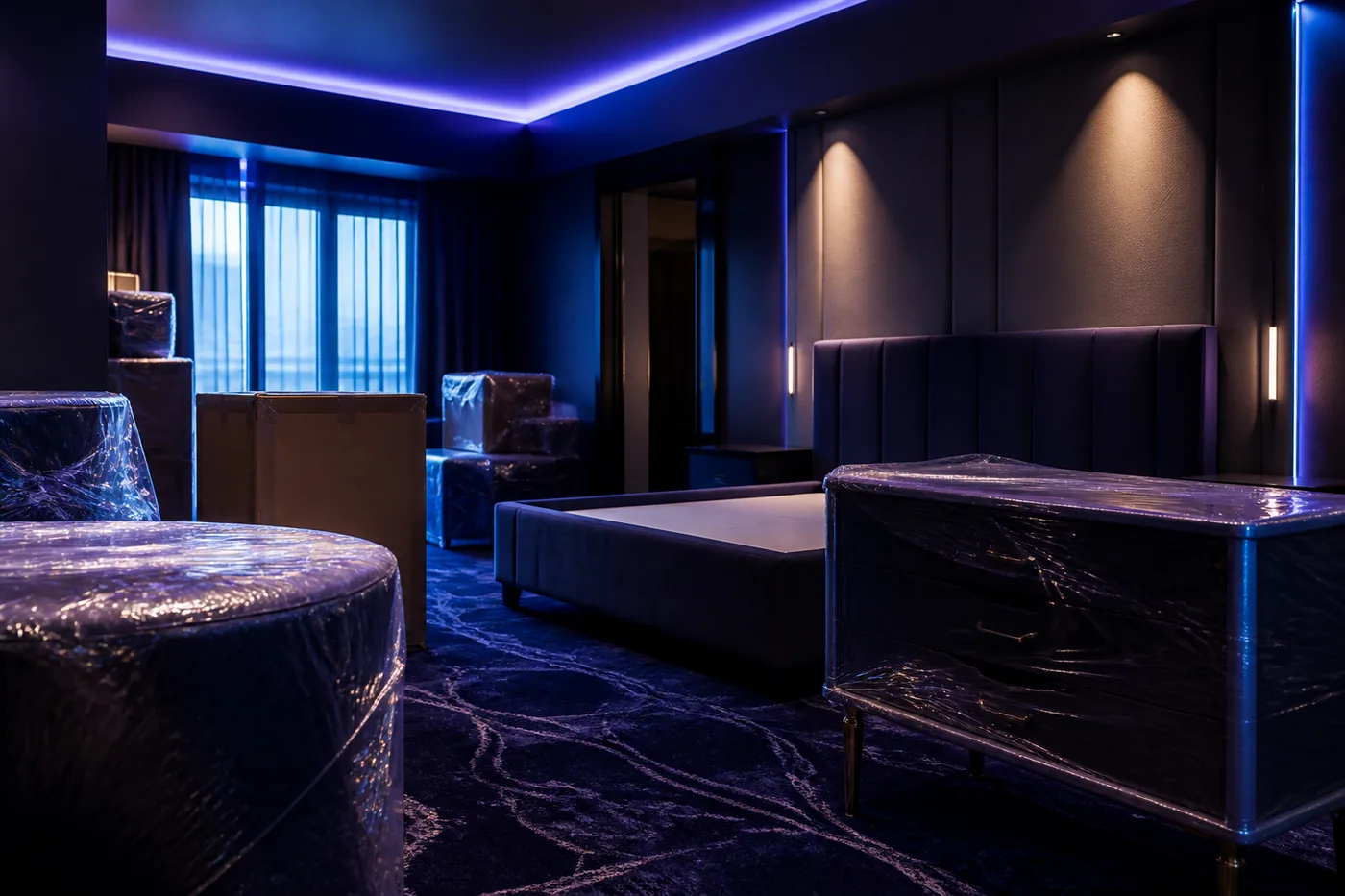
An FF&E budget is built one of three ways depending on your project: hotels budget per key (per room), restaurants and venues budget per seat, and offices budget per workstation or per square foot. Get the unit metric right, apply honest benchmarks, add the soft costs everyone forgets (freight, warehousing, installation, tax, spares), and you have a number a lender will believe.
We built these budgets for a living, and we've watched what happens when the proforma number was invented in a conference room. Here are the real benchmarks and the method.
What should a hotel budget for FF&E per key?
Working ranges for guest room FF&E (casegoods, seating, beds/headboards, lighting, window treatments, and artwork, but not construction and not OS&E):
- Economy / midscale: roughly $6,000–$12,000 per key
- Upper midscale / upscale: roughly $12,000–$25,000 per key
- Upper upscale / boutique / luxury: $25,000–$50,000+, with luxury flags going well beyond
Add public areas (lobby, lounge, meeting space, pool deck), which on full-service properties can add 25–50% on top of the guest room total. Renovations run cheaper than new builds per key (some items survive), but PIP renovations mandated by a brand rarely leave you much choice on scope.
Two per-key notes from the trenches: ADA rooms and suites cost more per key than standard rooms and get averaged away in early budgets, and ongoing FF&E replacement is real. Management and franchise agreements typically reserve about 4% of gross revenue for it, because guest rooms get renovated every six to eight years. Deeper hotel-specific numbers live in our hotel furniture cost guide.
What should a restaurant budget for FF&E per seat?
For dining room furniture (chairs, tables, booths, barstools, but not kitchen equipment):
- Fast casual / cafe: $100–$250 per seat
- Full-service mid-scale: $250–$500 per seat
- Upscale / heavy custom (booths, banquettes, premium finishes): $500–$1,000+ per seat
Kitchen equipment is a separate, usually larger budget. The split and the combined approach is in our food service FF&E guide. Event venues budget the same way per seat, typically $60–$150 per seat for quality stack/banquet seating programs at volume.
What about offices?
Per workstation (desk, task chair, storage, share of common-area furniture): roughly $1,500–$4,000 for standard open-plan fit-outs, $5,000+ where private offices and premium lines dominate. Per square foot shorthand: $15–$40 per usable square foot for typical fit-outs. Office pricing is the most discount-driven corner of the industry, so quotes swing wildly. The pricing rituals are decoded in our contract furniture guide.
What line items does every first FF&E budget forget?
This is the section to screenshot. Product cost is only 75–85% of a real FF&E budget. On top of the furniture number, add:
- Freight: 8–15% of product cost. More for small orders and remote sites.
- Receiving, warehousing, staging: 2–5%. Someone has to take delivery, inspect it, and hold it until the site's ready.
- Installation: 3–12% depending on complexity (stack chairs into a hall vs casegoods up a hotel tower).
- Sales tax where applicable. On a big project this is not a rounding error.
- Attic stock / spares: 2–5% on seating and fabric so future replacements match. Skipping this is the classic year-three regret.
- Contingency: 5–10%. Damage, shortages, the spec change ownership demands after the model room. On our projects, contingency has never been returned unspent. Not once.
Stack those and the honest multiplier is roughly 1.25 to 1.40 on product cost. A $200K furniture selection is a $260K FF&E budget. When a proforma shows the bare product number, the gap comes out of somebody's opening month.
How do I build the budget, step by step?
The method we use on every project:
- Count the units honestly. Rooms by type (including ADA and suites), seats from the current floor plan, workstations from the test fit. Unit counts drift during design; re-baseline the budget when they do.
- Assign a benchmark tier per area. Guest rooms at midscale, lobby at a tier up (public spaces punch above their class), back-of-house at utility grade.
- Price the top ten items for real. In most budgets, ten line items are 60–70% of the spend: guest room casegoods sets, dining chairs, booths, banquet tables. Get actual quotes on those; benchmark the rest. Ten phone calls converts a guess into a budget.
- Apply the soft-cost stack from the section above. All of it. Yes, even the contingency.
- Phase it against the calendar. Deposits (typically 30–50%) go out months before delivery. The cash-flow curve matters as much as the total. Long-lead items need money earliest; the lead times guide maps which those are.
How do I cut an FF&E budget that's too high?
In order of preference, because these are not equal:
- Cut scope, not grade. Fewer lounge groupings, simpler window treatments, art program trimmed. Visible quality survives.
- Re-spec lookalikes. Many designer selections have functional twins at 50–70% of the price. This is the single highest-value exercise in procurement. We've cut six figures from budgets without changing how a room photographs.
- Push quantity into fewer SKUs. One chair at 300 units beats three chairs at 100 units each on price, freight, and spares logic (bulk math here).
- Last resort, and we mean last: drop durability grade. The failure math on putting light-duty product into heavy duty cycles is brutal and documented in what commercial grade means. Cutting grade in a high-traffic space isn't saving; it's borrowing at terrible interest.
What we never do: cut the freight, install, spares, or contingency lines to make the total look better. Those costs don't vanish when deleted from the spreadsheet. They just arrive later, angrier.
How does the FF&E budget fit into the overall project budget?
Three interface points where FF&E budgets get mangled by their neighbors:
- The construction budget boundary. Built-in millwork, site-built banquettes, and attached fixtures belong to construction; freestanding furniture belongs to FF&E. Decide the boundary item-by-item early, in writing, because anything both budgets assume the other one owns simply doesn't get bought. Anything both claim gets designed twice. The definitional rules are in what is FF&E.
- The financing structure. Lenders commonly fund FF&E separately from real estate through equipment loans, FF&E allowances in the construction facility, or lease financing, each with its own draw schedule and documentation demands. Your deposit calendar (30–50% down, months before delivery) has to fit inside the lender's release schedule, and discovering a mismatch in month eight is a genuinely bad afternoon. Show your lender the FF&E cash-flow curve, not just the total.
- The value-engineering season. When construction runs over (and it runs over), the FF&E line is the easiest thing to raid, because it's the last money spent. Defend it with data: a budget built from real quotes with the soft-cost stack itemized survives VE meetings; a single lump-sum line gets a haircut by acclamation. This is the self-interested reason to build the budget properly, beyond mere correctness.
And once the project opens, the budget doesn't end: furniture wears on a schedule (hotels reserve roughly 4% of revenue for exactly this), and the tax side of the ledger has its own logic, covered in the depreciation guide.
The short version
Pick the right unit metric, use honest benchmarks, price your top ten items for real, multiply product cost by 1.25–1.40 for the full landed picture, and phase the cash. That's a budget that survives contact with reality.
If you'd rather stress-test yours against actual quotes, that's a normal Tuesday for us. Send us your list or your proforma line and we'll tell you if the number is honest. If it's not, better to hear it from us than from your opening week.