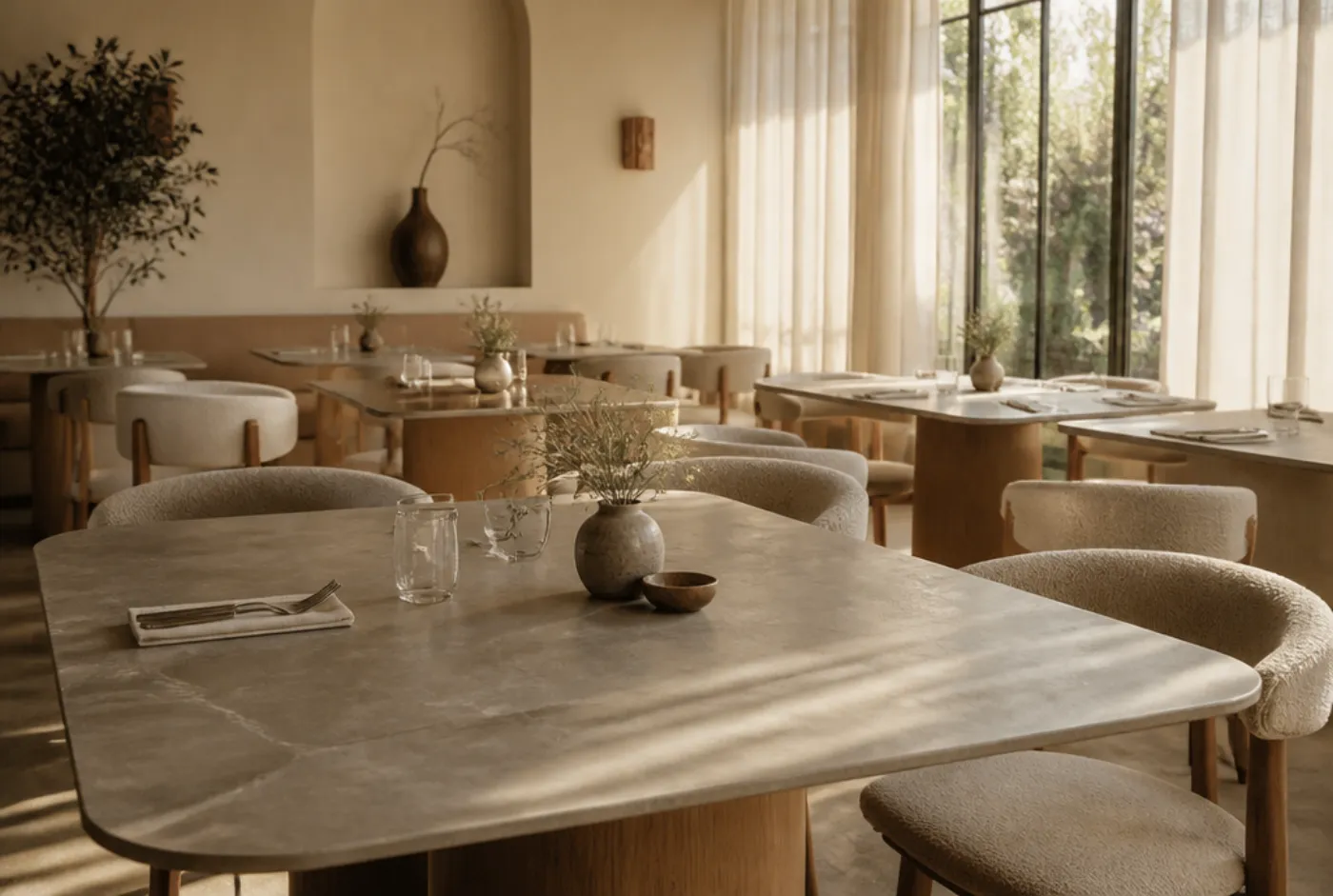
Sintered stone is a slab made from natural mineral powders (feldspar, silica, clays, mineral pigments) compacted under thousands of tons of pressure and then fired at roughly 1,100 to 1,300°C until the particles fuse into one dense body. No resin, no binder, no glue. That single fact is why it behaves the way it does: published specs for the major lines put water absorption under 0.1 percent, surface hardness around 6 to 7 on the Mohs scale, and heat tolerance well past anything a kitchen pass can hand it. It is, functionally, an accelerated version of what the earth does to rock over geological time.
We started quoting sintered stone table tops seriously about four years ago, mostly for outdoor terraces where nothing else was surviving. It has since crept indoors on nearly every project where the operator has been burned once by a scorched or stained top. Here's the material, honestly, including where it costs you.
How is sintered stone actually made?
Three steps, and the order matters:
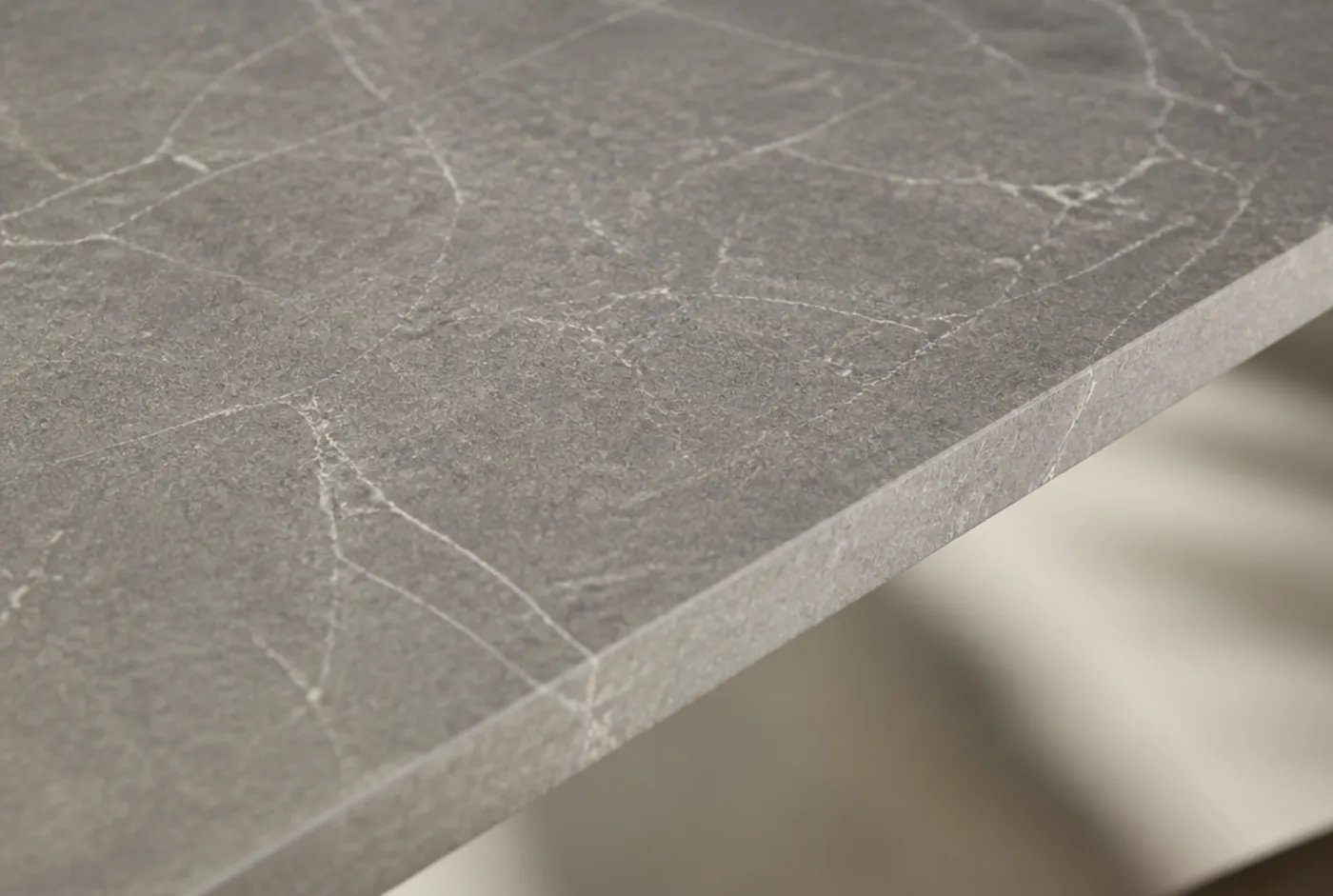
- Blending. Quarried mineral powders are milled and mixed to a recipe. The colour and veining are pigments mixed into the body or applied and then fired in, so on full-body and through-vein products the pattern runs into the slab rather than sitting on it like a printed film.
- Compaction. The powder is pressed under enormous force. Manufacturers quote press ratings in the thousands of tons; the point is that the slab is already dense before it ever sees heat.
- Sintering. The kiln run fuses the particles without fully melting them. What comes out is a single vitrified body with essentially no interconnected pore structure.
Compare that to engineered quartz, which is ground stone held together with roughly 7 to 10 percent polyester resin, cured rather than fired. Same shelf in the showroom, completely different material science. The full head-to-head is in our sintered stone vs quartz breakdown.
What does it actually do better on a restaurant table?
Four things we can point at in operating dining rooms:
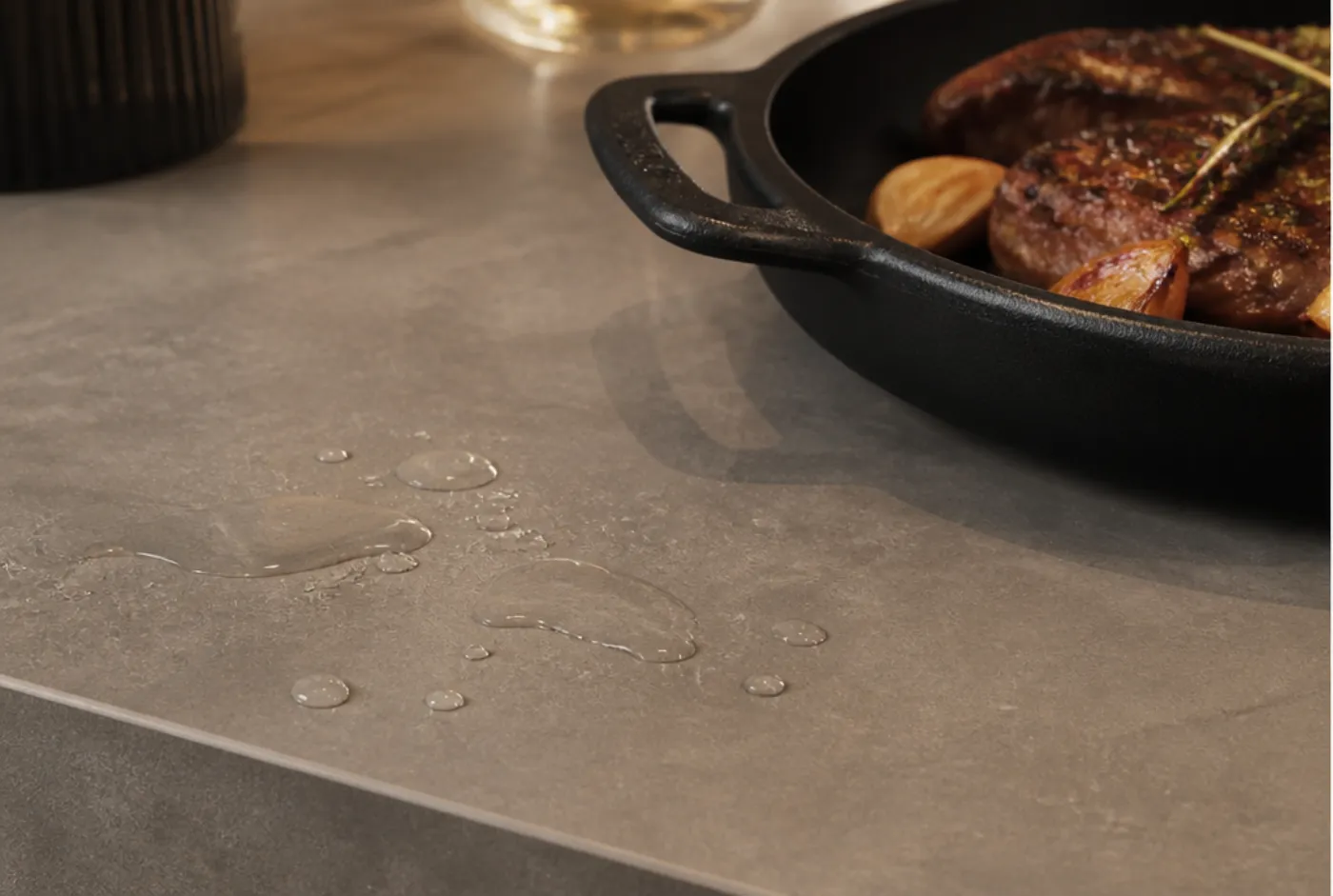
- It doesn't absorb. Red wine, turmeric, beet oil, espresso, sanitizer left in a puddle overnight by the closing crew: with absorption under a tenth of a percent, there's nowhere for pigment to go. We have never replaced a sintered top for staining. That's not a marketing line; it's just what the absorption number implies.
- Hot pans don't mark it. Fired at four figures, the surface is indifferent to a 400°F skillet. In service that means sizzle platters, tagines, and hot stone plates land directly on the table without a trivet ritual nobody follows anyway.
- It doesn't yellow outdoors. No resin means no UV degradation pathway. This is the reason it dominates patio work: a resin-bound top on a south-facing terrace shifts colour inside two seasons, and the contract vs consumer outdoor furniture rules apply doubly to horizontal surfaces baking in the sun.
- It shrugs off cleaning chemistry. Quat sanitizer, bleach dilutions, degreaser, alcohol. The finishes that die first in commercial service are usually coatings; there is no coating here to kill.
Where does sintered stone actually fail?
We'd rather you hear this from us than from a broken table.
Edges and corners chip. The material is hard, and hard means brittle. A 12mm slab takes an impact at an unsupported corner far worse than wood does: a bus tub swung into a table corner can take a crescent out of it. Mitered edges (two faces glued to look like a thick slab) are the most vulnerable geometry of all. Where we can, we spec eased or slightly radiused corners on high-traffic aisles and accept the aesthetic compromise.
It cannot be repaired. A scratched wood top gets sanded. A chipped sintered top gets replaced. Build that into your spares plan: on a fifty-top dining room we order two or three extra tops, not zero.
It cannot be modified in the field. No installer is trimming an inch off a sintered top on a loading dock. Cutting requires diamond tooling, water, and someone who does it for a living. Every dimension has to be right on the purchase order, which is one more reason we push the layout-first sequence in our restaurant seating layout guide before anything gets ordered.
The base has to be honest. Which brings us to weight.
How thick and how heavy?
Slab stock generally arrives in three thicknesses, and table tops are usually fabricated from the middle two:
- 6mm: cladding and vertical work. We don't use it for tables.
- 12mm: the workhorse table-top thickness. Roughly 6 pounds per square foot.
- 20mm: heavier, more impact-tolerant, used where the design wants visual mass. Roughly 10 pounds per square foot.
Run the arithmetic before you fall in love with a size. A 30-inch round in 12mm is about 4.9 square feet, so call it 30 pounds of top. The same round in 20mm is closer to 50. A 30x48 rectangle in 20mm lands around 100 pounds before the base.
That weight is not a problem; it's a spec input. It means:
- Bases must be sized up, not reused from your old laminate program. Under bar-height sintered tops especially, we go a base class heavier than the equivalent wood top; the physics are in our bar height vs counter height guide.
- Full-perimeter or wide-spider support beats a small three-arm spider under a heavy top. Point-loaded stone flexes exactly once.
- Freight and install change. Two people per table, not one. Pallet counts and delivery labour both go up, and that belongs in the number your FF&E logistics plan carries, not as a surprise on install day.
What should I ask a supplier before ordering?
Five questions, and we answer all five without being asked because we'd rather you compared like for like:
- Thickness and edge detail: 12mm or 20mm, and is that a mitered edge or a true full-thickness slab edge?
- Full-body, through-vein, or surface-decorated? It matters at the chipped corner, where a surface-only pattern reveals a different colour underneath.
- Finish: matte, polished, or textured. Polished shows dry sanitizer streaks under warm restaurant lighting more than matte does. In dim rooms, matte every time.
- What base is it engineered for, at what top size, and is the base rated for that weight at that height?
- Replacement availability: can you buy the identical top in year three, and what's the lead time? Colour programs do get retired, and commercial furniture lead times on imported stone are not overnight.
The short version
Sintered stone is fired mineral with no resin in it: non-porous, heat-proof, UV-stable, chemical-tolerant, and effectively immune to the staining that kills most restaurant tops. In exchange you accept brittleness at corners, zero repairability, no field modification, and real weight that your bases and your install crew have to be specified for. For patios, high-abuse dining rooms, and any operator who has already replaced a top once, that trade reads very well.
Weighing it against wood or laminate for a specific room? Send us your table sizes, quantities, and whether it's indoors or out and we'll price the sintered version against the alternatives side by side, including the base upgrade, because quoting the top alone is how people get surprised.