
The standard banquet chair is about 17 to 18 inches wide, 20 to 22 inches deep, and 32 to 36 inches tall, with a seat height of 17 to 18 inches and a seat width of 15.5 to 17 inches. That's the answer if you just need a number for a floor plan.
But we've supplied thousands of these chairs, and the spec sheet only matters because of what those numbers do downstream: how many guests fit at a 60-inch round, how high a stack goes before a volunteer can't lift it, and whether your storage closet actually holds the fleet. So let's walk through each dimension the way we'd walk a client through it.
What is the standard banquet chair size?
Here's the working spec we use when a client says "just a normal banquet chair":
- Overall width: 17–18 inches
- Overall depth: 20–22 inches
- Overall height: 32–36 inches (crown-back styles run taller than flat-backs)
- Seat height: 17–18 inches from the floor
- Seat width: 15.5–17 inches between the frame rails
- Seat depth: 15–17 inches
Two things worth knowing about that range. First, "banquet chair" is a shape, not a standard — there's no regulation forcing manufacturers to agree, so a chair from one factory can be a full inch wider than the same-looking chair from another. If you're adding to an existing fleet, measure what you own before you order. Chairs that don't gang or stack together are two fleets, not one.
Second, the width number is the one that compounds. An inch of extra width per chair times ten chairs around a round table is ten inches of crowding you can feel at a wedding. Which brings us to spacing.

How many banquet chairs fit at each table?
The chair dimension and the table diameter do this math together:
- 60-inch round: 8 chairs comfortably, 10 if the host insists (elbows will touch)
- 72-inch round: 10 comfortably, 12 tight
- 48-inch round: 6 comfortably
- 8-foot rectangle (30 x 96): 8 comfortably (4 per side), 10 with end seats
For room planning, we budget 10 to 12 square feet per seated guest for banquet rounds — that covers the table, the chairs, and the push-back space behind them. If you want to run your own room, our 200-guest table math guide walks the same arithmetic for any guest count and table style.
What weight rating should a banquet chair have?
Most contract-grade stacking banquet chairs are rated somewhere between 250 and 500 pounds, and we don't spec anything under 250 for venue duty. A chair that hosts two hundred events a year isn't just holding a seated adult — it's holding the guest who drops into it sideways, the one who tips onto the back legs during speeches, and occasionally the groomsman standing on it.
A few honest notes on ratings:
- The rating tells you about the frame, not the whole chair. Ask what standard the number comes from. The one we look for is ANSI/BIFMA X5.4, the commercial seating test — a chair that's passed it has been cycle-tested, not just loaded once in a lab.
- A higher number isn't automatically a better chair. A 500-pound rating on a 12-gauge steel frame with sloppy welds is worth less than a 300-pound rating on a chair with clean joinery and a real warranty behind it.
- Ask about the warranty in years, not adjectives. Five years on the frame is a reasonable ask for a chair doing serious event volume. We go deeper on what to demand from a big order in our guide to buying banquet chairs in bulk.
How much does a banquet chair weigh?
This number matters more than buyers expect, because somebody sets these chairs up and tears them down every single event:
- Aluminum frames: roughly 8–10 pounds per chair
- Steel frames: roughly 10–14 pounds per chair
That 3-to-4-pound difference sounds trivial until you multiply it by a stack. Ten steel chairs on a hand truck is 120-plus pounds of chair before you add the cart; ten aluminum chairs is closer to 90. If your setup crew is volunteers or a two-person banquet team flipping a room twice a day, aluminum earns its higher unit price in labor and backs. If the chairs mostly live in one arrangement, steel is fine and cheaper.
How high do banquet chairs stack?
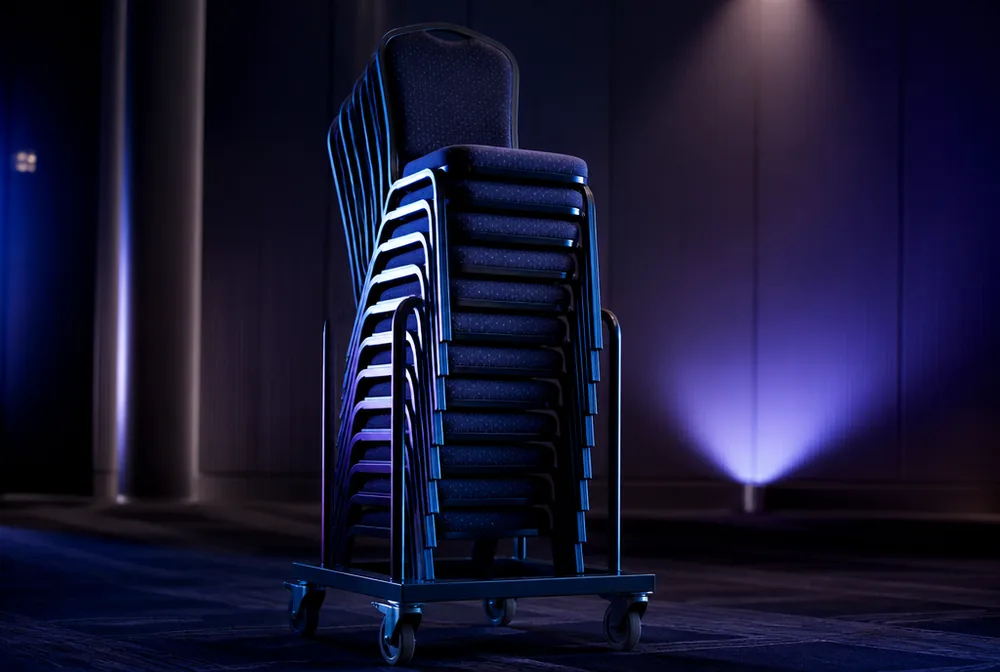
Most banquet chairs stack 8 to 10 high on a dolly, and a stack of ten typically stands somewhere around five and a half to six feet tall. The first chair sets the base height, and each additional chair adds roughly 3 to 4 inches depending on the frame design — a spec sheet will list this as "stacking increment," and it's worth actually reading, because a chair with a 5-inch increment eats your closet dramatically faster than one at 3 inches.
The stack height interacts with three real-world limits:
- Human reach. Lifting a 10-pound chair onto a stack above your shoulders is how chairs get dropped and frames get bent. Most crews top out at 8 high without a step.
- Door height. A loaded dolly has to roll through your storage door upright.
- Manufacturer limits. Overstacking is the most common cause of frame damage we see, and it voids warranties. If the sheet says 10, the answer is 10.
We wrote a whole piece on the closet math — square footage per hundred chairs, cart choices, ceiling clearance — in our guide to storing banquet chairs, because storage is the dimension question nobody asks until the chairs arrive.

What about ganging — do the chairs need to connect?
If your hall ever sets theater-style rows — conferences, ceremonies, graduations — check whether the chair gangs, meaning it links to its neighbors with built-in connectors. Many jurisdictions require connected rows above certain assembly occupancies, so this can be a code question, not a preference; your fire marshal has an opinion and it wins.
Dimensionally, ganging matters in two ways. Connectors add a fraction of an inch between chairs, which changes row-length math on long rows — 25 chairs at 18.5 inches effective width is nearly a foot longer than 25 at 18. And ganged rows need the chairs to be the same chairs: connectors rarely bridge between models, which is one more reason fleet consistency beats bargain-hunting a second brand. For row spacing itself, we plan 36 inches back-to-back as a working minimum so guests can sit without kneecapping the row ahead, and more where codes or comfort demand it.
Do banquet chair dimensions change the price?
Not directly — but the spec decisions that ride along with dimensions absolutely do. A wider seat usually means more foam and fabric; an aluminum frame at the same size costs more than steel; a taller crown back is more chair to upholster. If you're trying to figure out what your whole room should cost, chair by chair and table by table, we break the real ranges down in our banquet furniture cost guide.
The pre-order checklist
Before any banquet chair order leaves our desk, we confirm:
- Width and depth against the table sizes and the room plan (our table math guide covers it if you haven't)
- Seat height at 17–18 inches for standard 30-inch tables
- Weight rating of 250 pounds minimum, with the test standard named
- Chair weight matched to who's actually moving them
- Stacking height and increment, checked against the storage room
- Ganging compatibility if rows are ever part of the plan
- Fleet match — measured against any chairs the venue already owns
None of this is complicated. It's just seven small numbers that are cheap to check before the truck arrives and expensive to discover after.
If you'd rather hand it off: we supply banquet seating to venues, halls, and rental fleets, and checking spec sheets is genuinely the part of the job we enjoy. Send us your headcount and your room dimensions and we'll tell you what to order — and what it should really cost, landed.