
Plan on roughly 60 to 90 square feet of storage per 100 stacking banquet chairs — that's the stacks themselves plus the aisle space to actually reach them — and confirm your ceiling height, door width, and cart plan before the order ships. That's the short answer to the question almost nobody asks until two hundred chairs are sitting on a loading dock.
We've been in the room for that moment more than once. The chairs are beautiful. The closet is not big enough. Let's make sure that's never your story.
How much floor space does a stack of banquet chairs take?
A single stack of banquet chairs occupies about the footprint of one chair — call it 20 by 22 inches, roughly 3 square feet — plus breathing room so stacks don't scrape each other. In practice we plan 4 square feet per stack.
Most banquet chairs stack 8 to 10 high (the spec sheet will say — believe it, because overstacking bends frames and voids warranties). So the raw math for 100 chairs looks like this:
- 100 chairs ÷ 10 per stack = 10 stacks
- 10 stacks × 4 sq ft = 40 sq ft of chairs
- Add 50 to 100 percent for aisles and access = 60 to 90 sq ft total
That access allowance is the part people cut, and it's the part that matters. A closet where every stack touches the next one holds chairs beautifully and releases them miserably — your crew has to unbury the back row every changeover. Storage you can't circulate in isn't storage; it's a chair coffin.
Scale it up: a 300-chair fleet wants 180 to 270 square feet; 500 chairs wants 300 to 450. If those numbers made your storage room feel small, better to know now.

How tall is a stack of ten chairs?
Stack height is the base chair's height plus a per-chair increment — most banquet chairs add about 3 to 4 inches per additional chair. A 36-inch chair with a 3.5-inch increment stacks ten high at:
- 36 + (9 × 3.5) = just under 68 inches — about 5 feet 8 inches
Now put that stack on a dolly that adds 6 to 8 inches, and you're pushing a load around 6 feet 2 inches tall. Check it against:
- Door heights on the storage room and every doorway between it and the ballroom (standard 80-inch doors are usually fine; older buildings surprise you)
- Ceiling fixtures and sprinklers — fire code generally wants storage kept at least 18 inches below sprinkler heads, so a low-ceilinged closet loses more height than you'd think
- Human reach — loading the tenth chair over shoulder height is how chairs get dropped; many crews stack 8 high by choice and take the extra floor space
The stacking increment varies enough between models that it belongs on your comparison sheet. We cover it alongside the other spec numbers in our banquet chair dimensions guide.
Do you really need chair dollies?
Yes, and we'll die on this hill. Chairs without carts get dragged, and dragged chairs become damaged chairs at a pace that makes the cart look free.
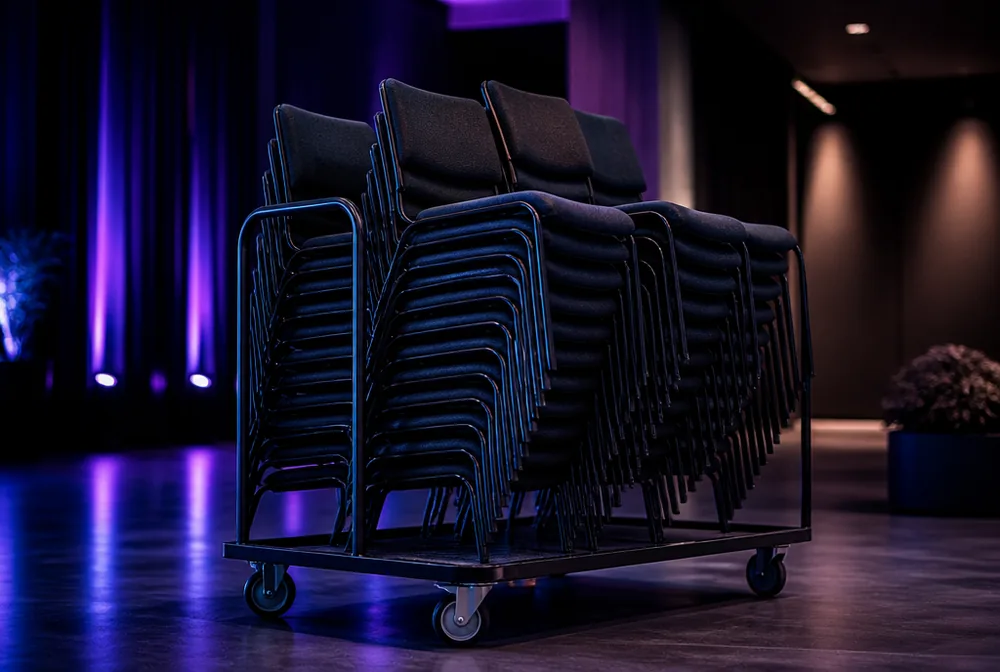
- Standard chair dollies hold one stack — typically 8 to 12 chairs depending on the model. They're the right answer for most halls.
- High-capacity chair trucks carry 2 to 3 stacks side by side for big rooms with long push distances.
- How many: if you flip rooms on a clock (afternoon ceremony, evening reception), buy one dolly per stack so the whole fleet moves at once. If changeovers are leisurely, one dolly per 2 to 3 stacks works — the crew shuttles.
Match the dolly to the chair, not the other way around. Dollies are model-specific enough that a mismatched pair rocks, and a rocking stack on the move is a slow-motion accident. When we quote a chair fleet, the dollies are on the same purchase order — order them together and confirm compatibility in writing.

What about the tables?
Chairs get the attention, but rounds are the storage hogs. A 60-inch round stored on a vertical table truck takes its diameter in wall length; a typical truck holds 6 to 10 rounds in about 15 to 20 square feet. Rectangles stack flat on their own carts. For a 200-guest hall (25 rounds plus rectangles and cocktails), budget another 100 to 150 square feet beyond the chair numbers above.
If you're still assembling the full fleet list, our banquet hall equipment checklist covers the whole inventory — including the transport gear — and our 200-guest table math guide covers how many chairs and tables the room actually needs before you compute a single closet.
The storage-room walkthrough we do before any order
Ten minutes with a tape measure, in this order:
- Measure the room — usable floor area, minus anything already living there (it's never empty; there's always a Christmas tree)
- Measure the ceiling and subtract sprinkler clearance
- Measure every door and corridor between storage and ballroom, width and height
- Check the floor path — thresholds, ramps, and elevator dimensions if storage is on another level
- Run the math — stacks, carts, tables, aisles — against the fleet you intend to buy
- Leave 15 percent empty. Fleets only grow, and the spares you buy with the original order (always buy the spares) need a home too
One more habit worth stealing from hotel banquet departments: chalk or tape the floor. Mark where each dolly parks, the same way a kitchen tapes its stations. It sounds fussy until the first Saturday your crew reloads a 300-chair closet in twelve minutes because every stack has an address — and until the fire inspector asks you to prove the exit path through that room stays clear.
If the math comes up short, the fixes in order of preference: a chair with a tighter stacking increment, stacking 10 instead of 8 with a step stool in the room, wall-mounted racking for dollies, or — honestly — buying fewer, better chairs and renting overflow for the three events a year that exceed capacity.
Does the storage environment matter?
More than people expect, especially for upholstered chairs:
- Moisture is the enemy. A damp basement or an outbuilding with temperature swings will mildew fabric seats and corrode budget frames within a couple of seasons. If the only available storage is questionable, that's an argument for vinyl seats over fabric at purchase time — vinyl wipes down and doesn't hold moisture.
- Sunlight fades unevenly. A storage area with a window fades the outward-facing side of every stack, and a fleet that's half-faded reads as two mismatched fleets. Cheap curtains fix it.
- Concrete floors and bare aluminum frames get along fine; dragged steel frames and concrete generate scuffs and screech. Carts solve this too — noticing a theme.
- Keep a simple count. Tape a laminated inventory sheet inside the door: how many chairs, how many per stack, how many out for repair. Fleets shrink by ones and twos invisibly, and the venues that count are the venues that still have full capacity in year five.
Storage changes what chair you should buy
This is the real reason we write storage into the buying decision instead of treating it as an afterthought: a chair that's an inch narrower with a half-inch tighter increment can shrink a 500-chair storage requirement by a full parking space. When storage is tight, that spec beats a prettier crown back every time. And if you're buying at volume, freight cartons have their own storage moment on delivery day — our guide to buying banquet chairs in bulk covers what arrives and how.
If you want a second pair of eyes on the whole equation — chair spec, stack math, carts, closet — that's exactly the kind of puzzle we like. We supply banquet seating to venues of every size. Send us your room dimensions and your storage dimensions, and we'll spec a fleet that fits both.