
Bulk pricing on banquet chairs is real, but it doesn't move smoothly — it moves in steps. The meaningful quantity breaks typically land around 50, 100, and 300-plus chairs, freight is quoted separately and can swing the total by more than the discount did, and the single best thing you can do before committing to hundreds of anything is spend fifty dollars on one sample chair.
We've supplied volume seating to venues, hotels, and rental fleets for fifteen years. Here's how the bulk game actually works, so you can play it instead of getting played by it.
How do quantity breaks actually work?
Suppliers price seating in tiers, and the tiers follow their costs: carton quantities, pallet quantities, and container quantities. That's why the breaks cluster where they do:
- Under 50 chairs: you're paying close to list. This is fine — small orders cost suppliers real handling time.
- 50–99: the first genuine discount tier at most suppliers, often in the range of 5 to 10 percent off small-quantity pricing.
- 100–299: the tier where most venue orders should land, and where negotiation stops being rude and starts being expected.
- 300 and up: you're now interesting. At this volume the conversation can change from "our price is" to "what price do you need" — and at the top end you're brushing against container-direct quantities, where the economics change entirely.
Two practical moves. First, if your need is near a break, buy through it. If you need 92 chairs and the tier turns at 100, the 8 extra chairs are often nearly free after the discount — and you needed spares anyway (5 to 10 percent, always; finishes get discontinued and matching later is a nightmare). Second, ask where the breaks are instead of guessing. It's a normal question. A supplier who won't tell you is telling you something.
What does freight look like on a bulk chair order?
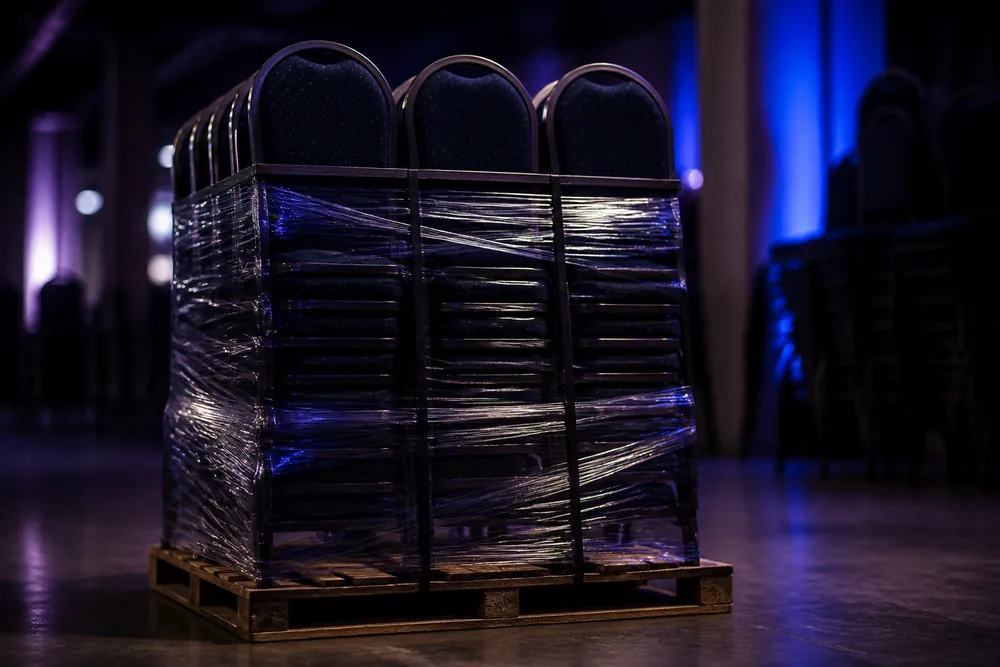
Chairs ship boxed — usually 2 to 4 per carton — stacked onto pallets, and the freight quote depends on how efficiently your order fills them. This is the pallet math that quietly decides whether your "great chair price" was actually great:
- Small orders ship LTL (less-than-truckload): you pay for the space your pallets occupy on a shared truck. Odd quantities that leave a pallet half-full still pay for the pallet.
- Large orders approach full truckload, where the price per chair drops noticeably because you're buying the truck, not the space.
- Destination details matter as much as distance. No loading dock means a liftgate fee. Inside delivery is its own charge. A residential-zoned hall pays residential rates. Tell the supplier the truth about your dock situation upfront — the surprise charges cost more than the honest quote.
On typical banquet furniture orders we see freight land at 8 to 15 percent of the furniture subtotal. Which is exactly why we quote landed cost — delivered to your door — and why you should demand the same from anyone you compare us against. A chair that's $3 cheaper and $6 more expensive to ship is not cheaper. We go deeper on the whole budget picture, tables and carts included, in our banquet furniture cost guide.
Should you order a sample chair first?
Yes. Non-negotiable, and we say this as a team that sells the convenience of skipping steps: never skip this one.
A sample tells you things no spec sheet will:
- Whether the welds are clean and the frame sits square on the floor
- Whether the foam feels like it'll survive year three or just the showroom
- Whether the stacking bumpers actually protect the frame below
- Whether it matches chairs you already own — "banquet chair" is a shape, not a standard, and dimensions drift an inch between factories
Most suppliers sell samples at unit price and credit it against the order. Fifty dollars and ten days versus discovering at chair 400 that the seat pan creaks — that's the cheapest insurance in procurement. While you have the sample, verify the dimensions against our banquet chair dimensions checklist, and stack two if you can get two.
What lead times should you expect on volume orders?
- Stocked chairs, standard finishes: typically 2 to 4 weeks to ship. The catch is the word "stocked" — 300 units of one SKU in one fabric can exhaust a warehouse, and your order quietly becomes...
- Factory orders and custom fabrics: typically 8 to 14 weeks, sometimes more. Import-direct container orders live here too.
The failure we see most isn't slow lead times — it's optimistic ones. Ask the supplier to confirm stock on your full quantity in writing before you commit a date to your event calendar, and build two weeks of cushion between promised delivery and your first booking. Nobody has ever regretted the cushion.
What's negotiable besides the unit price?
Buyers fixate on price per chair; suppliers have more levers than that, and some of them are worth more than another dollar off:
- Payment terms. Standard on volume orders is a deposit with balance before shipment. Established buyers can push toward smaller deposits or net terms on the balance — worth more than a discount if cash is tight during a buildout.
- Freight absorption. At the right volume, "freight included" appears if you ask. Sometimes it's a real concession; sometimes it's the discount you'd have gotten anyway, relabeled. Compare landed either way.
- Dollies bundled. Chair carts at a package price on the same PO — you need them regardless, and the supplier's cost on them is lower than yours.
- Spare parts kit. Glides, stacking bumpers, a yard of the seat fabric. Costs the supplier almost nothing, saves you a discontinued-parts hunt in year four.
- Holding the price for a phase-two order. If you know a second room is coming, ask for the quote to be honored for six or twelve months. The worst answer is no.

What should the warranty and paperwork say?
For a fleet doing real event duty, here's the baseline worth asking for — and what we put in writing on our own quotes:
- Frame warranty: 5 years on commercial use. Shorter is negotiable on a budget chair; "one year" on a premium price is a flag.
- A named weight rating with the standard behind it — ANSI/BIFMA X5.4 is the commercial seating test worth asking for by name.
- Fabric/foam coverage stated separately from the frame — they're usually shorter, and that's normal.
- Replacement continuity: ask how long the finish and fabric program will remain available. The honest answer is "no promises," which is exactly why the spares go on the original PO.
- Freight damage terms: who files the claim, and how long you have to report. Open cartons and count before signing the delivery receipt — noting damage on the receipt is what keeps the claim alive.
Don't forget what arrives with 300 chairs
A bulk order shows up as a wall of cartons on a truck. Before delivery day, know where the fleet lives: stack heights, dolly counts, and the closet square footage. Our banquet chair storage guide has the math, and the dollies belong on the same purchase order as the chairs — model-matched, in writing. And if you haven't locked the quantity yet, work your room through our 200-guest table math guide first; the cheapest chairs are the ones you don't over-order.
The short version
Buy through the nearest quantity break, add the spares, demand landed pricing, order the sample, confirm stock in writing, and put the dollies on the PO. That's the whole playbook — none of it is secret, it's just tedious, and tedium is where money leaks.
Or hand us the tedium. Volume seating is the core of what we supply — banquet seating for halls, venues, and rental fleets — and our own quantity breaks work exactly the way this guide describes. Send us your quantity and your delivery address, and we'll price it landed — real delivered numbers you can compare honestly.